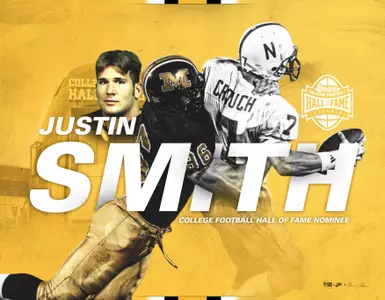
Mizzou Great Justin Smith Nominated for College Football Hall of Fame
6/4/2019 10:45:00 AM | Football
Smith to Appear on Ballot for Consideration with the 2020 Class
COLUMBIA, Mo. – Former University of Missouri All-American defensive end Justin Smith is a nominee for selection to the National Football Foundation (NFF) & College Football Hall of Fame. Smith's inclusion on the ballot was announced yesterday by NFF President & CEO Steve Hatchell, and he is one of 76 players and five coaches from the Football Bowl Subdivision up for selection as part of the 2020 class.
Smith, a native of Holts Summit, Mo., wreaked havoc on opposing teams' offenses in a three-year career (1998-2000) under former Coach Larry Smith, establishing himself as one of the top defensive linemen in Mizzou history. "Smitty" won 1st-Team All-American honors as a junior in 2000, before bypassing his final year of eligibility and entering the 2001 NFL Draft. He was drafted fourth overall by Cincinnati, tying him for the highest draft pick ever in Mizzou history.
At Mizzou, Smith won Big 12 Defensive Freshman of the Year honors in 1998 when he totaled 86 tackles, a team-best 13 tackles for loss and 3.5 sacks, while making 11 starts as a true freshman. He also received freshman All-American honors from several national outlets. As a sophomore, Smith was a 1st-Team All-Big 12 selection in 1999 when he made 92 tackles, 16 tackles for loss and eight sacks. He followed with a monster junior season, which included 97 tackles and school-record tackles for loss (24) and sack (11) totals. He won 1st-Team All-American honors and was a unanimous 1st-Team all-conference selection.
Smith went on to an outstanding pro career, playing 14 seasons total with the Cincinnati Bengals (2001-07) and the San Francisco 49ers (2008-14). He was a five-time All-Pro selection (2009-13) with the 49ers and was voted a 1st-Team All-Pro player in 2011. He came in second in balloting for the NFL Defensive Player of the Year Award in 2011 after his outstanding season. Previously, he broke the Cincinnati Bengals' rookie sacks record in 2001, when he had 8.5 sacks. Perhaps most impressively, Smith started 185 consecutive games until an elbow injury sidelined him for the last two weeks of the 2012 regular season. He returned in the playoffs to help lead the 49ers to Super Bowl XLVII. Smith retired after the 2014 season, having played 221 games, making 880 total tackles, including 119 tackles for loss and 87 sacks.
The College Football Hall of Fame ballot was emailed to the more than 12,000 NFF members and current Hall of Famers whose votes will be tabulated and submitted to the NFF's Honors Courts, which will deliberate and select the class. The FBS Honors Court, chaired by NFF Board Member and College Football Hall of Famer Archie Griffin from Ohio State, and the Divisional Honors Court, chaired by former Marshall head coach, longtime athletics director and NFF Board Member Jack Lengyel, include an elite and geographically diverse pool of athletic administrators, Hall of Famers and members of the media.
The announcement of the 2020 Class will be made in January 2020 in the days leading up to the College Football Playoff (CFP) National Championship in New Orleans. The 2020 College Football Hall of Fame Class will officially be inducted during the 63rd NFF Annual Awards Dinner on Dec. 8, 2020, at the New York Hilton Midtown. They will also be honored at their respective schools with an NFF Hall of Fame On-Campus Salute, presented by Fidelity Investments, during the 2020 season.
The player criteria for Hall of Fame consideration include:
- First and foremost, a player must have received First-Team All-America recognition by a selector organization that is recognized by the NCAA and utilized to comprise their consensus All-America teams.
- A player becomes eligible for consideration by the Foundation's Honors Courts 10 full seasons after his final year of intercollegiate football played.
- While each nominee's football achievements in college are of prime consideration, his post-football record as a citizen is also weighed. He must have proven himself worthy as a citizen, carrying the ideals of football forward into his relations with his community and his fellow man, with love of his country. Consideration may also be given for academic honors and whether the candidate earned a college degree.
- Players must have played their last year of intercollegiate football within the last 50 years.* For example, to be eligible for the 2020 ballot, the player must have played his last year in 1970 or thereafter. In addition, players who are playing professionally and coaches who are coaching on the professional level are not eligible until after they retire.
Once nominated for consideration, all FBS player candidates are submitted to one of eight District Screening Committees, depending on their school's geographic location, which conducts a vote to determine who will appear on the ballot and represent their respective districts. Each year, approximately 15 candidates, who are not selected for the Hall of Fame but received significant votes in the final selection, will be named automatic holdovers and will bypass the district screening process and automatically appear on the ballot the following year. Additionally, the Veterans Committee may make recommendations to the Honors Court for exceptions that allow for the induction of players who played more than 50 years ago. The Honors Court annually reviews the Hall of Fame criteria to ensure a fair and streamlined process.
Of the 5.33 million individuals who have played college football since Princeton first battled Rutgers on Nov. 6, 1869, only 1,010 players have earned induction into the College Football Hall of Fame, or less than two one-hundredths of a percent (.02%) of those who have played the game during the past 150 years. From the coaching ranks, 219 individuals have achieved Hall of Fame distinction.
For all the latest on Mizzou Football, stay tuned to www.MUTigers.com and follow the team on Twitter (@MizzouFootball) and like the team on Facebook and Instagram.